
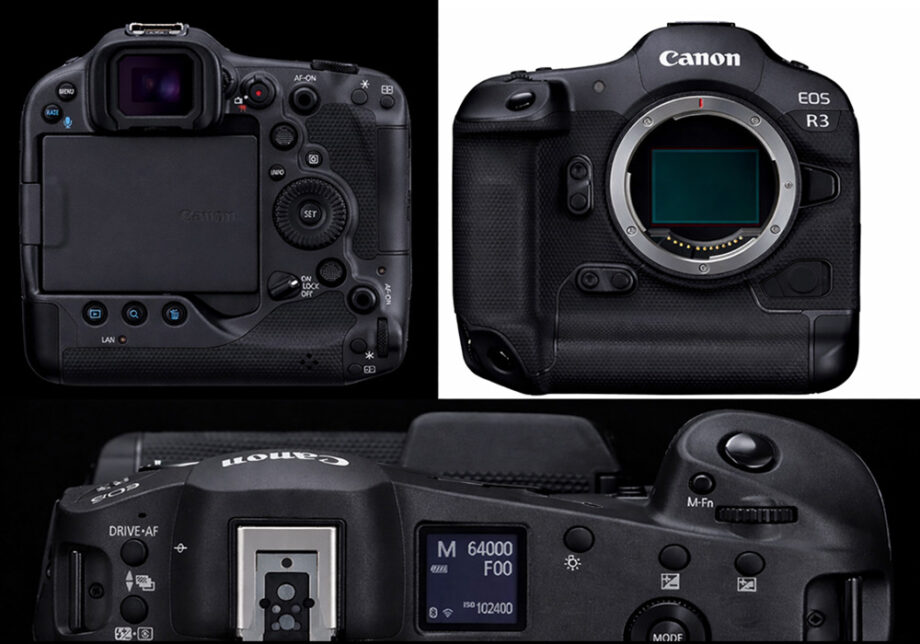
The Canon EOS R3 is a full-frame mirrorless camera built without compromise. It combines a 24.1MP stacked CMOS sensor, 30fps burst shooting, and a revived Eye Control AF system, blending Canon’s DSLR heritage with modern mirrorless technology. The R3 is designed for sports, wildlife, and photojournalism. It’s quick, user-friendly, and made for photographers who don’t want to miss a shot.
There’s a certain kind of photographer who’s heard the mirrorless pitch before and remained unconvinced. They know their DSLR ergonomics by muscle memory, and they’ve been quietly skeptical that smaller would ever mean better. The Canon EOS R3 was built for exactly that person. Considered the mirrorless successor to the 1D X Mark III, it is about 400g lighter than the DSLR version, yet still maintains a deep grip and full-height pro body essential for professionals.
This isn’t a stripped-down reinvention. Canon is firmly committed to prioritizing performance in the areas that matter most.
Sensor, speed, and low-light muscle
At its core, the R3 runs a stacked CMOS sensor designed for fast readout, rapid shooting, and low rolling-shutter video. The 24.1MP resolution invites comparison, but resolution alone is a poor measure of what this camera does.
Where the R3 earns its reputation is in low-light performance. It produces high-quality images at ISO 12800, and its RAW files can easily recover three or more stops of underexposure. The essence of classic Canon colour is vibrantly present in every detail.
The R3 can shoot at 30 fps with the electronic shutter, without a viewfinder blackout, allowing bursts of up to 100 frames in C-RAW and JPEG. The mechanical shutter achieves an impressive 12 frames per second, making it ideal for scenarios where silence is not a primary concern and raw performance takes precedence.
| Feature | Spec |
|---|---|
| Sensor | 24.1MP full-frame stacked CMOS |
| Burst rate | 30fps electronic / 12fps mechanical |
| Low-light AF | Down to -7.5 EV |
| Image stabilisation | 5-axis IBIS, up to 8 stops |
| Viewfinder | 5.76M-dot OLED EVF, 120fps |
| Video | 6K RAW internal, 4K up to 120p |
| LCD | 3.2-inch vari-angle touchscreen |
Eye Control AF: the future dressed in nostalgia
Eye Control AF uses the photographer’s pupil to adjust the focus point, allowing them to keep the subject in focus without moving their thumb. Canon originally debuted this on the analogue EOS 3 in the late 1990s. The R3 brings it back with Dual Pixel CMOS AF underneath, rebuilt for a completely different era.
Calibration takes patience and occasionally a fresh start. Once set up, the system works reliably and quickly becomes the preferred method for selecting focus in dynamic situations.
The subject detection includes people, animals (such as birds in flight), and motorsport vehicles, allowing tracking of up to 10 registered individuals via a firmware update. The R3’s focus system is among the best globally, offering fast, flexible, accurate, and easy-to-use performance.
Battery life and field reliability
The R3 can deliver 7,000 to 9,000 shots on a single charge, sufficient for a full-day professional event without needing a spare battery. It uses the same battery format as Canon’s DSLR lineup, so third-party options are already widely available and affordable.
Boot time is near-instant. Controls are duplicated across both grip orientations for seamless landscape-to-portrait transitions. EF lenses can be used with an adapter, offering autofocus performance that matches or exceeds that of native DSLR bodies.
The bottom line
The EOS R3 isn’t trying to win the megapixel race or shrink itself into a jacket pocket. It’s a camera engineered for one purpose: to perform without hesitation when the moment demands it. Sports photographers, photojournalists, wildlife specialists, and event shooters will find a camera that aligns with their workflow rather than disrupts it.
For Canon DSLR loyalists who’ve been waiting for a genuine reason to cross over, the R3 makes the case clearly. It keeps everything that made the 1D series trustworthy and replaces what held it back. The camera feels like a natural evolution instead of a forced change, which is crucial in professional photography.